Wednesday, 29 January 2014

Not fair


People regularly tell me that I'm not being fair. I ask others to be clear about tasks to me, to try and stay calm, to stay true to what they promised, understanding me and some other things. The unfairness here, is that those are things that I struggle with a lot. I have trouble keeping organised in my head, and as such also have trouble verbalizing what I mean in a short and clear sentence. Because I sometimes have trouble regulating my emotions, I have a hard time staying calm in emotional situations. My unorganised mind, combined with moments of hyperfocusing, sometimes has me forgetting about appointments and things that I promised. My Autism can also make it difficult sometimes to understand another person's emotions.
These are a few examples of things that I need others to do for me, which I have trouble with returning the favor.

It's true, it's not fair at all. I totally agree with you and I wish it was different. I wish I could return the favor and provide all the things that you're providing for me!
The problem is that I can't. That's exactly the reason I need you to provide those things for me. Those things are things that I have trouble with providing for myself. I need others to keep my head organised and calm and to help me understand the world and myself, because it's so very hard for me. In some cases even impossible.

This is a hard thing to grasp for some people. "But if you know how hard it can be for yourself, then why would you ask it from someone else?" My answer to this is simple: Would you ask a paralysed person to walk, just because he needs you to push his wheelchair?

If I was just as capable of doing something like the rest of you, but just found it a hard job to pull off, then I wouldn't ask someone else just to make it easier on myself. That's just mean. But in this case it's a lot harder, and sometimes even impossible, for me. It's so hard, that sometimes it's making life itself nearly impossible. Just as impossible as it is for a paralysed person to walk.
That's why sometimes Autism can be very unfair, but it's not being mean or lazy. It's that we sometimes need your help a lot and we thank you from the bottom of our hearts, even if we can't always express that properly. Thank you!

Monday, 27 January 2014

Finally the right help


Remember that I was trying to apply for money for proper guidance? Also, remember that I got totally lost in all the forms needed to do so, and that I also couldn't get the information organised on paper properly?
I'm finally getting proper help with that!

Let's start from the beginning, because there's more good news. In the city that I live in, they started a type of sheltered housing that's just right for me! It's specifically for people with Autism. First, they'll let me live in a type of sheltered housing for 2 to 3 years, where they train me on how to take care of a household on my own. This way, I can get used to the big change, without having to wait about 2 hours before someone helps me with my panic attack (which by then has probably already passed, and having all the psychological damage done already). I can also learn all the household chores with someone standing right next to me, teaching it to me in a very autism friendly way. The driving school story probably told you how important autism friendly teaching is for me.

After those 2 to 3 years, I would go to live in a 'studio'. This is a one-floor house (at least, that's what I understood from it). They're rebuilding a school nearby into 5 of these studios. In this way I can live on my own, but still have the guidance counsellors nearby, just in case. This is perfect! I don't think I need intense guidance my whole life, but I don't think I can do it on my own in one go either. That step is just too big. There are other places with a similar type of protect housing nearby, but then I'm usually mixed up with other people with different types of psychological disorders. Having guiding people who are specialised in autism, just works way better for me. They know exactly what they're doing!

Now, here's the glitch. To get that type of housing, I'll need to apply for an even slightly different kind of fund than what I was applying for. Isn't this just maddening? I explained that to the people from the sheltered housing and they immediately understood and got me in touch with someone who specifically helps people with applying for, and managing, these funds for a living. GREAT!

She has been absolutely amazing for me. She took the time to explain everything that was going to happen, to me. She then asked me tons of questions and used the answers to make a report herself. So I didn't have to do that. I only had to check if I agreed with what was in the report.
I sent her my feedback with what needed changing in my opinion, and after changing that, she sent the report to the proper place. About a week later (that was fast!) I got a letter from the fund-people (CIZ. I don't know how to properly translate that to English. It's so specific...) with an appointment to have a talk. I could bring 1 person and I decided upon bringing that person who's helping me with all this, because she understands this so well! She agreed.

Of course, this isn't promising anything yet. If it turns out that I can't get the proper funding, then all of these plans won't happen. Then I'm back at square one. So don't cheer yet. We're not out of the woods. But it might be a start? And at least I'm not left to figure this out on my own anymore. Let's focus on that.

Friday, 24 January 2014

Squease pressure vest


On the 4th of October I went to the NVA (Nederlandse Verening Autisme. Translation: Dutch Autism Association) convention. At this convention there were a lot of professionals speaking on stage and there was an Autism information market.

At this information market I tried on a pressure vest. It has been scientifically proven that deep pressure, like a hug, can reduce sensory input. This is why these pressure vests have been made. In the crowdedness of the information market, I could test the vest very well and it really worked! The only trouble was, that it was too expensive for me.

Later the company 'Squease' contacted me through Twitter. They asked me to try one of their vests, in exchange for a review and some help with some little things that needed to be done. Of course I agreed! I'm very thankful that they offered me this.

Their vest is slightly different from the one at the convention. The vest at the convention applied pressure by little balls in the vest that applied pressure when putting the vest on. This worked great, but was also pretty heavy. This was meant to put on at the moment there's a need for less sensory input.

The vest Squease provided me with, however, has little lines of air pockets. You can just wear the vest, which is very light, under your clothes. When you're in need of a relieve from sensory input, you simply pump the vest up (the pump can be disconnected, so you only have to carry that around in your handbag, or pockets, or something like that). I have already tried this. Even when it's pumped up, you can hardly see it through your clothes.

This is what a Squease pressure vest looks like and how it's used.
 Credit for the picture goes to Squease.

For a look at how the Squease pressure vest works, how they thought of it, or maybe even buy one, you can look here: http://www.squeasewear.com

To write a proper review, I would of course have to wear it in different situations. This has already proven to be hard, as it's hard for me to add a new routine to my day. The new routine that has to be added now, is to remember to put the vest on before doing something that might provide me with too much sensory input (socialising, going into the city, parties... things like that). To give you an idea of how difficult I find this: It took me about 6 years, as a child, to remember to always put on my glasses before leaving the house.
So, I hope I'll remember to put the vest on soon, as there are plenty of occasions on which I'd like to test it.

I can talk about one thing already though: Getting the right pressure vest.
When I first got my pressure vest, it was a bit too small. It has to be a bit high up, as you can see on the pictures on their website, but it was even a bit smaller than that. This caused for it to end up right in the soft spot between your belly and your ribs. This hurt! It also looked ridiculous, as it made me look pregnant, because it pushed my belly down.

I stopped by the office at Squease for a counselling session. They were very nice and immediately got me the right size vest and adjusted the mid-sections to my waist (these mid-sections are made of Velcro and can be used to adjust the vest to your waist size). This felt a lot better! I could immediately feel the difference, even when pumping the vest up. I tried it under my clothes too and it looked great. I also got a separate, longer, tube for the pump which I could use if I wanted to keep my pump attached to the vest, but put the end of it in the pocket of my regular vest.
I can advise anyone who wants a vest to make such an appointment first, if possible. If not, you can also ask for some advise through Skype, e-mail, the phone or some other type of contact. They're really nice people who are very willing to help. Asking them really makes a difference.

So that's my experience with the vest so far. It fits really nicely now and all there's left to do is to try it in daily life, and try to get it in my routine to put my vest on when I'm about to do something that might cause too much sensory input.

Thursday, 23 January 2014

Experience expert!


I know it has been a while and that most of you probably thought I have stopped updating my blog. For a while I was actually considering of doing just that, because I didn't have much interesting things to say.

But that changed! Recently I have started voluntary work as an experience expert for Autism at 'MEE Utrecht, Overvecht en Gooi'. That's a foundation that supports people with a disability in all kinds of ways.
My tasks will include giving presentations, talk to clients who need contact with someone who understands them, and test new systems. In the future more tasks might be added.

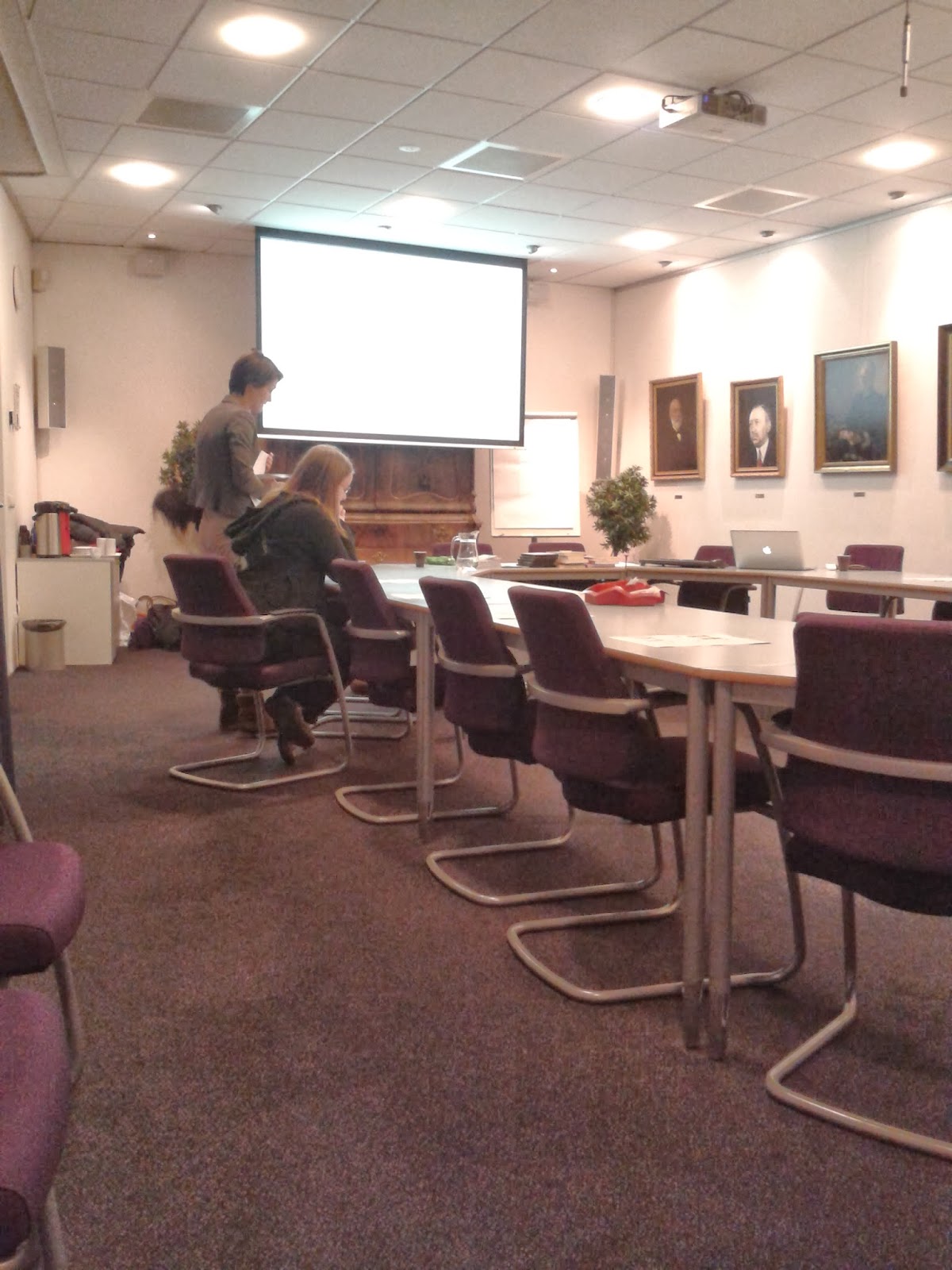
Last Tuesday I had my first presentation. A psychologist gave a training about Autism and how to communicate with someone with Autism and I was asked to give a presentation at the end of the training, as to give some insight in how living with Autism can possibly look like.

Of course I was very nervous before the presentation. It's something new and new things are scary, even more so if you're on the spectrum. The people at MEE were absolutely marvellous in guiding me through this! They gave me as much clarity on everything that was going to happen as they could. They also helped me with putting together my presentation, as I was having a hard time with deciding which things were important enough to include (I could talk for hours about Autism and still only touch the tip of the iceberg!) and which things I could leave out.

The day of the presentation started in absolute chaos. Because I was so nervous, I couldn't plan anything at all (and got a bit stubborn and didn't listen to my sister... Sorry!), which had me running late. Luckily my sister, who I asked to tag along for support and to maybe also tell a bit at the presentation, understood and helped me to get everything together on time.
When we arrived at the place of the presentation, we met the psychologist who would lead the training. She's very nice, understanding and knows what she's talking about.

We were then lead to the room where the presentation was to be held. Soon, we noticed the room was way too small to fit the amount of people who would be in the audience. Luckily there was another, bigger, room that was still empty and we could use it.

After switching rooms, we started setting everything up. Then we couldn't get the beamer to show the presentation. Luckily that was soon fixed by someone who worked at the location. After it was all set up, it was soon time to begin and... There was nobody.
We started getting nervous. What was all this about?

Again, luck was on our side. Someone managed to contact someone who was meant to be in the audience and we soon learned there was a communication problem. They would arrive half an hour later. Good, we weren't without an audience.

That was a very bumpy start of a first presentation, but hey, it's not like I'm not used to these kind of things, right? Happens all the time at the events that I help out at.
So I was soon able to grab myself together again and to greet everyone entering the room. Then the training started.

The training started with having a member of the audience try to have a fake in-take meeting with me and the psychologist, my sister and me gave feedback. After that the psychologist gave her presentation.

We had a lunch break and then it was time for me to give my presentation. I was still pretty nervous, but as soon as I was speaking, all my worries disappeared. I simply told everything that I wanted to tell and I was fuelled by the amazing questions that the audience asked me! I could tell they were very interested and the psychologist, my sister and a MEE employee confirmed that the audience was indeed very interested.

Afterwards the audience had to put to practice everything they learned about communicating with someone with autism in a short conversation with each other, and we gave feedback again. This last exercise really showed that they learned a lot. We hit home run!
One of them said: "There's so much that I would do differently now..."

After that the training was over and we said goodbye to everyone. While saying goodbye, everyone shook my hand and most of them thanked me for my presentation. A few even stopped a bit longer to tell me that they thought my presentation really struck a cord with them and was really an asset to the training. One of them told me she had a buddy with Autism and she could recognise a lot of what I spoke about.

I absolutely loved doing this presentation! Now that I know what it's like, I'm sure I won't be that nervous anymore the next time and I can't wait until I can do this again!

Tuesday, 24 September 2013

GOT MY DRIVER'S LICENSE!!! And an update

I GOT MY DRIVER'S LICENSE!!!

I kept screwing up, because I had terrible failing anxiety. Then I got myself an exam where they took my failing anxiety AND autism into account (they actually got someone from another city for me, to accomplish that. Isn't that nice of them?) and it helped a lot.

I'm allowed to drive in my parents' cars (my dad's work-car and our own) and I've already driven around in them for quite a bit around town, so I can get used to driving in another car. I'm slowly easing into it.

Getting my driver's license is a very big accomplishment for me. Of course, it is for most people, but there's an extra reason for me. I first started driving lessons with another driving instructor. This woman said she was skilled at teaching people with autism to drive a car. Well... She clearly wasn't. She had me do almost everything in a very short time span.

Then she told me that I had to fill in this form (Eigen Verklaring), in which there are several questions. One of them is whether or not you've ever been at a psychologist and/or had therapy. Of course my answer is yes. This form actually cost me 22 euros. (yes! For a piece of paper!) After that I would be summoned for a screening at a specialist, which would cost me a lot of money too. If he would find me fit to drive, then I would still have to do a medical driving test. IF I got through that test, THEN I would be a allowed to take my exams. Even then I'd just get my driver's license for 3 years max. (This will change starting the 1st of October! I didn't know that back then though) At the end of this all, I would've spent somewhere between 200 and 300 euros and still not be sure whether I'd be able to even get a driver's license or not.

I told my instructor that I thought that was horrible. A lot of people, including me, who even qualify for such a screening, are also in government profit. This means that they won't have a lot of money. Still they want those people to pay that much, just to know if they're even qualified to take their exam or not! And this is being forced upon them. If they want to drive, they will have to pay that much and still not be sure if they will eventually end up with a driver's license.

My instructor sympathised and she told me that I should just stop my lessons until I had gone through my medical driving test. Then, if I wouldn't get through the test, I wouldn't have spent that much yet. I asked her if I would be good enough for the test with that few (7) hours of lessons. She said that they would adjust to my level, that they just wanted to know if I had what it takes to even get on the road. Not how far I was in my lessons.

Relieved, I went through the whole progress (feeling my wallet getting lighter, metaphorically speaking). At the day of the medical driving test, I was told I had to drive there myself with a car that I had to rent from the driving school. Suddenly I was told I had to have the skills to drive the whole car myself, so I had to practice that by driving to the test myself. I asked how for God sakes they could ask that from me, seeing as I had 7 hours of time spent on the road, and there was a lot of time between those lessons and the test too. The instructor told me she couldn't remember having told me that I should stop taking lessons and that I had to face the consequences now. Like, seriously? I wouldn't just stop my lessons for fun, knowing that there would be a test, would I?

Well, I probably won't have to tell you that I dramatically failed my medical driving test. How was I to make it while having to control things I never learned to control?
I explained the whole situation to the man who was testing me, but my instructor kept insisting she never told me to stop my lessons and the man believed her and told me that it didn't matter anyway. He said that he could see that I couldn't divide my attention (ever tried to do several things you never did at the same time and tried to divide your attention between them without making a mistake? You'll fail. If you don't, you're probably a genius) and that if I can't divide my attention between my car and the rest of the world, I wouldn't be able to drive. He advised me that I would be better off in an automatic car, instead of driving stick.

I told the man again that I only had 7 hours of lesson time, which isn't enough for me to understand everything enough to divide my attention between them, but that I was sure that when I understood them, I would be able to use everything with much more ease and divide my attention.
The man and my instructor looked at each other and me and shook their heads. I kept insisting that it might even take me a year, but that I would make it. The man said "Well, a year half a half maybe! But even then I doubt it... I think you should try automatic and even then I can't promise anything..."

Isn't this a very grim outlook? I should drive automatic and even that wouldn't be sure...
I asked my instructor how she could think that she could teach someone with autism how to drive a car. Her response: "I have had other people with autism and they did fine..."
Wait, that was her proof? People, memorize this sentence please: "If you've met one person with autism, you've only met one person with autism."
I got angry and resolved. I went out to find someone who was ACTUALLY qualified to teach a person with autism to drive a car.

One day I was asked to show my talents at a table at an autism information market. I was in one room with three other people. One of them was a nice woman who was a driving instructor for people with autism!
I wasn't to be fooled again, so I asked what made her qualified to teach people with autism how to drive. She told me she actually had a 'Ster-opleiding' which would literally translate to a Star-education, which is an education to teach driving instructors to teach people with autism how to drive. She told me about the different techniques that she used and what an average lessons would look like.

I was completely amazed and knew that she was the right person. Just one thing... She only teaches how to drive stick. Not automatic.
I didn't care. If anyone was to drive me stick, it would be her. I took an introduction lesson and after that I immediately knew that I had the right person. She also told me "I have no idea why they told you that you wouldn't be able to drive. Nonsense. It won't be easy, but you're very fit to drive."

When I re-did my medical driving test, I happened to end up at the same man who tested me before. It had to be faith. This time I was fully prepared and I aced the test. I can still remember the look on his face and it still makes me smile.
I got through my theoretical test in one go too (I did take an individual test).
I didn't get through my exams in one go, but that was mostly due to my failing anxiety. The moment I got a failing anxiety exam, I aced that one too.

Everyone reading my blog: If people are telling you that you can't do a certain thing based on ridiculous assumptions, and you're sure that you can do it: Do it!
"Then what if I still fail?" Then at least you know for sure now and it won't be a 'what if' situation. But what if you DID make it? Then you wouldn't have someone else telling you what you can and can't do. The person who knows that the best is you.
Advice is a great thing and take it to heart, but nobody can tell you what you can and can't do. Decide that for yourself.


As for the update: I got the help that I needed to fill out the form to apply for the money to get the right guidance. I got all the information written down now. It just needs to be made in a good story. Suprisingly, I can write blogposts, but I can't make this story right... People keep telling me I have a low chance of getting this indication, seeing how strict the rules are now, and now my failing anxiety is acting up again. I fear that I write something down wrong and I cheat myself out of the right guidance. This makes me lock up completely.
My psychologist promised she would help me get through that, so next time I'll be bringing the form and all the information to her and we'll be working on that together.

So yea, I'm making progress. Slow progress, but progress nonetheless.

Thursday, 20 June 2013

A mess

Hey everyone. I know I keep promising to update my blog more often and then I don't. I'm sorry. It's because my head is such a mess. I'm all over the place. So I'm writing this on my mobile phone, in bed. No obligations in bed.

Life is just getting too confusing for me and it's making me lose track of so many things, even my physical therapist has begun pointing out things in my life that I'm forgetting. No I'm not talking about excercise. She actually remembers who I said I'd call better than me.

This is partly because soon I'll take my driver's exam for the third time and this many exams is draining my money.
But mostly it's because... well... I'm growing up. And I don't seem to cope with it as well as others seem to do, because of my autism and chronic fatigue. I need guidance in finding a living place for my own, for managing my house, managing finances, managing my household, etc. I also need medical care for my chronic fatigue. There are special budgets for people who need that much care. I've been trying to figure out how to get it for a year and a half. I've been to a lot of organisations for that.

I seem to finally understand what papers I need... But I don't understand the papers. I asked the guiding-organisation which I want to hire once I have that budget. They told me I need that budget first before they can help me. It's weird: I need guidance to be able to finance my guidance!

There actually turns out to be an organisation who provides help with such things for free. Yay! So I called them. They said they could come over, but needed some papers from my psychologist first (not the diagnosis paper. I have that. Other papers). I asked my psychologist. She explained to me that the organisation was wrong. They didn't need those papers.

Now I have to call back the guiding organisation to tell them my psychologist said they were wrong.

Oh and all this is just for papers to get an CIZ indication, which apparantly is just something you need in order to be ABLE to apply for the budget I need. So I need help with applying for that too.

Everything in adult life is so confusing to me, that I need help. In order to get that help, I need a budget. In order to get that budget, I need help... and apparantly that help is getting me the wrong information too!
So tomorrow I'll call that organisation again and see what they have to say.

Hey people in Health Care: why are you making people with autism run from stranger to stranger, and overload them with complicated information, in order to get the help that's supposed to make life a bit easier?

Sunday, 5 May 2013

Answering two question - Second


In my absence from my blog I have had two questions from two different people. I’ll try to answer them as well as I can. Today I’ll answer the second one. You can find the first one here: http://thedailydaysofanasperger.blogspot.nl/2013/05/answering-two-questions-first.html

When can we speak of an ‘overload’?
This is a terribly difficult question, which I have been thinking about for a long time. To me, this question needs two answers. First, I’ll have to define the thin line between simply being bothered by any kind of stimulation and actually having an overload. I’m not an expert, I can’t measure brain activity and I have no idea if my definition of this thin line is the same as someone else’s. So this will just be my interpretation.

The second part of my answer will need to be an actual definition of an overload. This answer has the same problems as the first. I’m not an expert, I can’t measure brain activity and I have no idea if my definition of an overload is the same as someone else’s. So this, too, will just be my interpretation.

Before I answer this, I have a question for my readers too: Does anyone know if there’s some accurate scientific research on this, so we can define this by science instead of just my point of view? If there is a research on this, please send it to me, or tell me where I can find it.

Now, as for the line between simply being bothered by stimulation and having a complete overload. To me, this is defined by the moment where (any kind of) stimulation makes you incapable of tuning it out and bothers you with other activities up to a point where every fibre of your being is telling you to either get rid of the stimulation somehow, or get out of there. When I say stimulation, I mean anything that’s bothering your senses. Being it sound, touch, sight, taste, smell, etc.
The moment where you feel the stimulation affecting your performance with anything, then that might be the first sign of an overload coming up and you should probably search for a way to get away from the stimulation.

Then there’s the second, and hardest, part of the question… A definition of an overload. Now, how do you define something that you feel? It’s like having someone, who never felt hunger, ask how hunger feels. I’ll try my best, though. I’ll try to do it in such a way that even someone who never had an overload, may have a sense of what it’s like. Even though I don’t think anyone will ever really get it without having had an overload. (note: Overloads aren’t just for people with autism. They just tend to have them more often and sooner.)

Ever had 3, or more, people trying to get your attention? You probably couldn’t follow any of it and yelled out, frustrated, something along the lines of: “One at a time please!!!” Such a moment is close to what an overload feels like (and also the reason why some people respond with yelling, or fighting, or things like that, to an overload. It’s frustration).

People with autism are usually a lot more sensitive to different kinds of stimulation. Life with autism is life unfiltered. All the different thing in the world enter our senses at the same time. I remember my biology book telling about how people can get used to a sound. It said: “If you put on a radio on loud while trying to make your homework, it will probably bother you. After a while you’ll probably hardly even hear it anymore.” I can hardly relate with this. Some soft sounds I can filter. But actual music in front of me? Nope.

Now imagine walking through a city and hearing all the sounds (I’m using sound as an example here, but any other sense, like smelling a perfume, can cause the same reaction) around you. You can’t filter anything. There’s people talking, cars driving, footsteps, bicycles, doors slamming, road workers, birds tweeting, mobile phones ringing, bus passes and traffic light sounds, etc.

Now you want to buy a sandwich and you still hear all these things, while you’re trying to politely respond to the salesman who’s selling you something. At the same time a baby in the diner decides it’s a good time to start crying. Now there’s the city sounds, a crying baby and a man talking to you, trying to get your attention all at the same time.

This is the same sensation as having 3, or more, people talking to you at the same time. But you can’t possibly tell the city, the baby and the salesman to ‘Shut up! One at a time!” right? So what do you do? You try to push through and end the conversation and having to be at that place as fast as you can. Then you walk out, while being exhausted, but you’re still in the city, which is already too much. Being exhausted from all the noise, the city is too much too. But you can’t tell the city to shut up either! Now you have to go home sooner than expected… You get on the bus, where you can’t even respond to the bus driver’s nice greeting anymore, as all the city noise is distracting you. Your head starts to hurt and all you want is to get to your nice and quiet home…

I hope this story nicely explained how an overload works. It’s not exactly a scientific way of explaining it. The short of it would be: Slowly but surely you have more and more trouble filtering everything entering your senses. This builds up, until you can’t take no more and start to have the basic ‘fight or flight’ survival response. I think the building up is the first warning signal that things are getting too much and that this signal shouldn’t be ignored. To me the moment that you resort to the ‘fight or flight’ survival response, is the moment where you can say you have an ‘overload’. The key is to recognise the warning signals and reduce the ‘overload-moments’.
You probably think “why couldn’t you just explain the whole thing with these last few sentences?’ Because I feel there’s a difference between knowing something and understanding something. The story might help to really understand the feeling of an overload. I hope it worked.